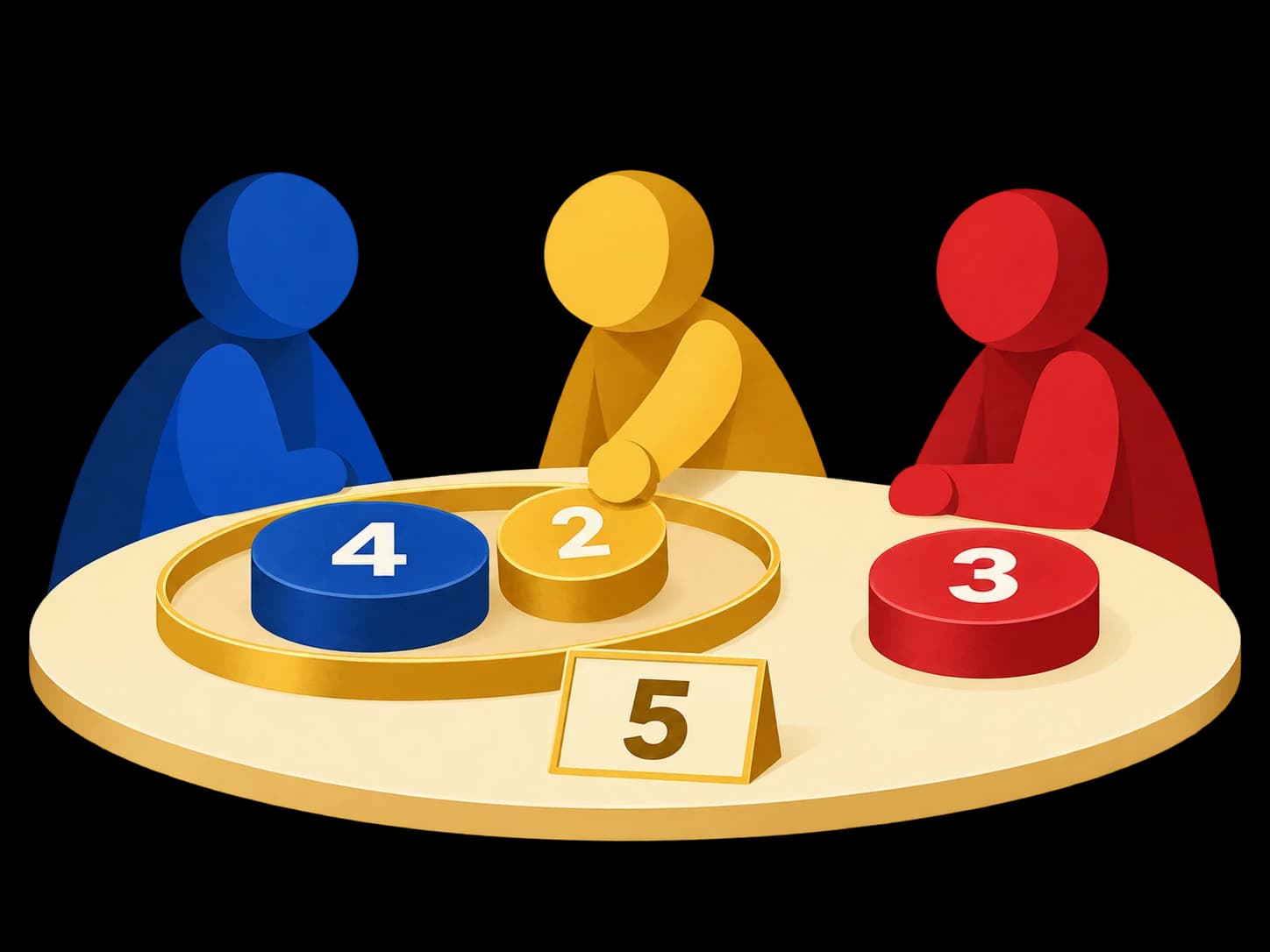
Cooperation & Coalitions
How should the gains from cooperation be shared?
Move from choosing against an opponent to evaluating agreements and groups. First study what two players can achieve together, then compare how larger coalitions share value and how individual members affect collective decisions.
A suggested learning path
Follow the sequence, or jump directly to the question that interests you. Each lab opens in Guided Learning; switch to Sandbox at any time to experiment freely.
- Step 1
Two-Player Cooperation
Understand feasible agreements and bargaining between two players.
Learning outcome: Map the feasible agreements of two players and choose one with transferable utility or Nash bargaining.
- Level
- Intermediate
- Time
- About 20 min per method
- Concepts
- Feasible set · Pareto frontier · Transferable utility · Nash bargaining

- Step 2
Coalitional Games
Assign values to groups and compare stability and allocation rules.
Learning outcome: Compare imputations, the core, the Shapley value and the nucleolus on one characteristic function.
- Level
- Advanced
- Time
- About 20 min per method
- Concepts
- Characteristic function · Core · Shapley value · Nucleolus

- Step 3
Voting Power
Apply coalition values to pivotal voters and distinguish votes from power.
Learning outcome: Measure Shapley–Shubik power from pivotal voters and separate voting weight from power.
- Level
- Intermediate
- Time
- About 15 min
- Concepts
- Weighted voting · Pivotal voter · Shapley–Shubik index